

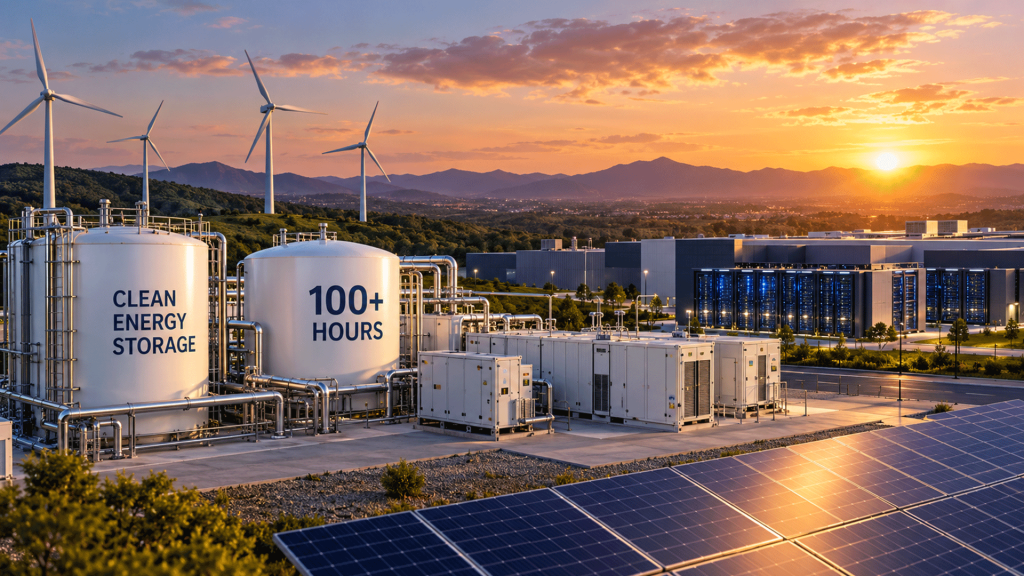
What if renewable energy could be stored not just for a few hours, but for several days? What would that mean for data centers, industrial facilities, power grids, and the reliability of the energy systems we depend on every day?
That possibility is getting closer.
New energy storage technologies are expanding the conversation beyond simply generating more renewable electricity. The next challenge is just as important: making clean energy available when it is needed, even when the sun is not shining or the wind is not blowing.
A recent agreement between Noon Energy and Sabanci Renewables offers a good example of where this transition is heading.
On August 13, 2026, in Palo Alto, California, the companies announced plans to develop projects combining renewable generation with ultra-long-duration energy storage (ultra-LDES). The proposed initiative could reach up to 1 GW of power and 100 GWh of storage capacity, with a focus on energy-intensive infrastructure such as AI data centers. Commercial deployment could begin as early as 2027.
More than a single technology announcement, this is an encouraging sign for the industry: energy generation, storage, and reliability are increasingly being designed as parts of the same system.
From storing energy for hours to storing it for days
The U.S. Department of Energy defines Long-Duration Energy Storage (LDES) as systems capable of delivering electricity for at least 10 hours. Storage lasting several days represents another level of flexibility for power systems with growing shares of variable renewable generation.
Noon’s technology is designed for this emerging space.
Its system uses reversible solid oxide fuel cells to convert electricity into stored chemical energy and later convert it back into electricity. According to the company, the architecture separates power, determined by the power block, from energy capacity, determined by the storage tanks.
In practical terms, this could make it possible to increase storage duration without scaling every component of the system at the same rate.
In January 2026, Noon reported more than 100 hours of discharge from a modular system and thousands of hours of operation. These are company-reported results, and large-scale performance will need to continue being evaluated as commercial deployment progresses.
Why does the industry need longer-duration storage?
Because electricity generation and demand are changing at the same time.
Solar and wind power continue to expand, but their output is variable. Meanwhile, industrial electrification, electric mobility, and digital infrastructure are increasing electricity demand.
Data centers make this challenge especially visible. The International Energy Agency estimates that global data center electricity consumption could grow from about 485 TWh in 2025 to 950 TWh by 2030, with AI-related demand rising even faster.
For a power grid, industrial plant, or data center, the issue is therefore not only how much electricity can be generated. It is also when that electricity is available and how the system responds when one source temporarily stops producing.
This is where renewable energy, energy storage, power generation, and grid reliability increasingly converge.
There will not be one solution for every project
Lithium-ion batteries will continue to play an important role in fast-response and shorter-duration applications. But flow batteries, thermal storage, compressed air, pumped hydropower, hydrogen, and other chemical storage technologies are also being developed for different operating needs.
For engineers, EPCs, integrators, and procurement teams, this changes the way projects should be evaluated.
The question is no longer simply, “What equipment do we need?”
It is also: How will it integrate? How reliable is it? What operating conditions does it require? How are moisture and contaminants controlled? What maintenance will it need? And can the system adapt as the project grows?
Where energy storage meets power generation
At Lectrodryer, these developments are closely connected to technologies we have worked with for decades.
In 1935, Lectrodryer designed a hydrogen drying system for hydrogen-cooled generators. That expertise in adsorption, drying, purification, and gas conditioning has evolved into solutions for modern power generation and Green Energy applications, including hydrogen drying and purification, natural gas and renewable natural gas treatment, and systems that blend hydrogen with natural gas for gas turbine applications.
Lectrodryer does not develop Noon Energy’s storage technology. Our expertise lies in another critical part of the energy system: helping gases, fuels, and auxiliary equipment operate under the conditions required for reliable power generation.
That distinction is important.
As the industry combines renewables, storage, hydrogen, natural gas, turbines, and advanced control systems, reliability will increasingly depend on how well all these technologies work together.
The Noon Energy–Sabanci agreement is therefore more than a story about a new storage technology. It is a sign of where the industry is heading: from producing cleaner energy to building energy systems capable of delivering it continuously, flexibly, and reliably.
